Landed cost vs total cost of ownership
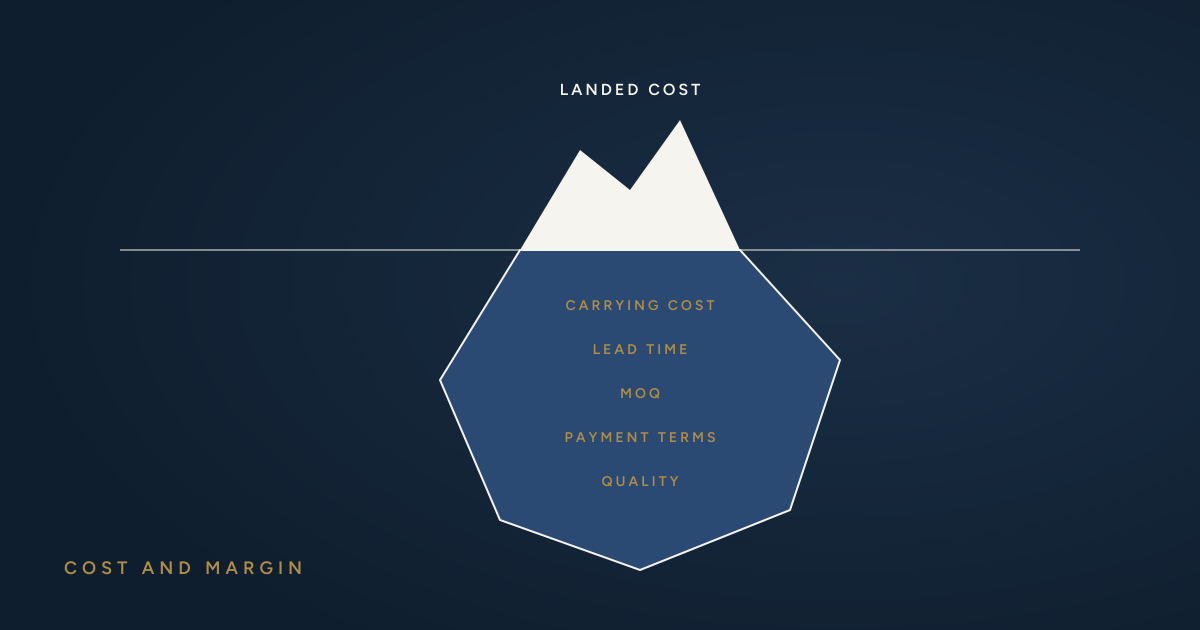
Landed cost tells you what a unit cost to get to your shelf. Total cost of ownership tells you what it cost to own that unit until it sold. Most DTC brands choose suppliers on the first number and pay for it in the second.
Landed cost: the shelf price
Landed cost is everything it takes to get one unit from the supplier into a sellable position in your warehouse:
- Product cost (FOB or EXW price)
- Origin charges, international freight and destination charges
- Duty, brokerage and customs fees
- Inbound receiving at your 3PL
It's the number you need for pricing and gross margin. It's also the number most supplier comparisons stop at.
Total cost of ownership: the real price
Total cost of ownership (TCO) adds the costs that come from owning inventory and working with a particular supplier. They rarely appear on an invoice, which is why they get ignored.
- Inventory carrying cost. Cash tied up in stock, storage, insurance, shrinkage and the risk the stock goes obsolete. Supply chain textbooks often put this at 20 to 30% of inventory value per year. For a DTC brand funding stock on expensive capital, it can be higher.
- Lead time. A longer lead time means more stock on the water, more safety stock in the warehouse, and slower reaction when a SKU takes off or dies.
- Minimum order quantities. An MOQ above what you'd naturally order leaves you holding excess stock, which carries cost every month it sits.
- Payment terms. Paying 30% up front and 70% before shipment means you fund the inventory for months before you sell it. Net terms change the picture entirely.
- Quality. Defect rates, returns, rework, inspection costs and the reviews a bad batch leaves behind.
- Management overhead. Time zones, communication, sampling rounds, travel and the cost of problems when they happen.
- Risk. Tariff exposure, single-source dependency and how hard it would be to move if something went wrong.
A worked comparison
The figures below are illustrative. A brand selling 1,000 units a month compares two suppliers for the same product.
| Supplier A | Supplier B | |
|---|---|---|
| FOB price | $10.00 | $11.20 |
| Landed cost per unit | $13.40 | $13.90 |
| Lead time, order to shelf | 90 days | 35 days |
| MOQ | 6,000 units | 2,000 units |
| Payment terms | 30% deposit, 70% before shipment | 30% deposit, 70% on arrival |
| Defect rate | 3% | 1% |
On landed cost, Supplier A wins by $0.50 a unit, or $6,000 a year.
Now the TCO view. Supplier A's MOQ and lead time mean the brand holds on average about four months of stock against Supplier B's two. At a landed cost of around $13.50 and a 25% annual carrying cost, the extra two months of stock (2,000 units, about $27,000) costs roughly $6,750 a year to hold. The 2-point difference in defect rate on 12,000 units a year is 240 units, which at landed cost plus return handling is around $4,000. Supplier A's payment terms also mean the brand pays for every order about two months earlier.
Supplier A is cheaper on the invoice and roughly $5,000 a year more expensive to own, before counting the cash-flow hit or the risk of being stuck with six months of a slow SKU.
How to use TCO without overcomplicating it
- Use landed cost for pricing and margin.
- Use TCO for supplier decisions, MOQ negotiations and any choice between cheaper-but-slower and dearer-but-faster.
- Keep it simple: landed cost, plus carrying cost on the average stock each option forces you to hold, plus expected quality cost. Those three cover most of the difference.
- Revisit it when anything material changes: a tariff, a freight spike, a new MOQ, or a SKU slowing down.
The cheapest unit price wins most supplier negotiations. It doesn't always win the P&L.
Frequently asked questions
What is included in landed cost?
Product price, inbound freight, insurance, customs duty and brokerage, and any tax you cannot reclaim, divided across the units in the shipment. Anything that happens after the goods reach your warehouse is not landed cost.
What does total cost of ownership add to landed cost?
The cost of holding the stock until it sells (storage, insurance, cash tied up), the cost of paying the supplier before the goods arrive, defects and returns, and the stock you have to hold because of long or unreliable lead times.
How do I compare two suppliers on total cost?
Put both through the same model: annual units, landed cost, order quantity (the larger of your MOQ and your order cycle), lead time, payment terms and defect rate. Our supplier TCO calculator does this in a minute.
Want this checked on your own numbers?
Start with a fixed-scope audit of your invoices, contracts and inventory data, or bring us in to fix a specific problem. Either way, the first call is free.
Book a call