Why payment terms matter as much as price: supplier terms and cash flow
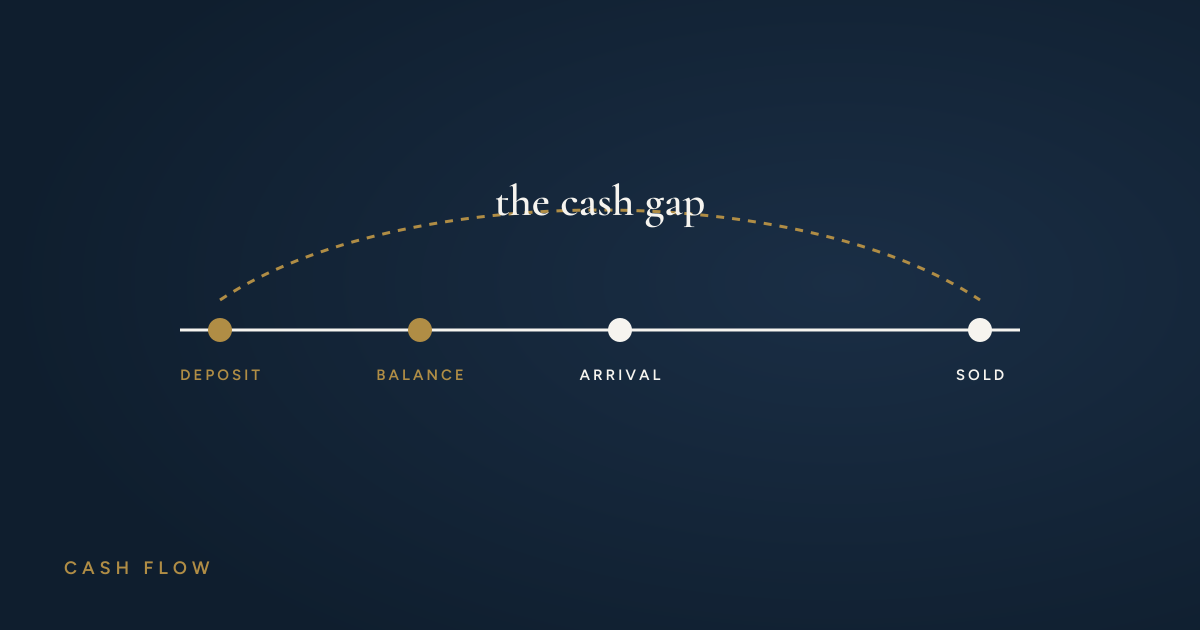
A profitable DTC brand can still run out of cash. The usual cause isn't margin, it's timing: paying for inventory months before it turns into revenue. Payment terms decide how long that gap is, which makes them as important as the unit price.
How the cash gap works
A typical import cycle for a brand buying from Asia:
- Place the order and pay a 30% deposit.
- Production takes 30 to 45 days. Pay the 70% balance before the goods leave the factory.
- Ocean freight and customs take 30 to 40 days. Pay freight and duty.
- Goods are received and sold over the next two to four months.
Some of the cash for that inventory leaves your account four to six months before the last unit sells. Every order you place while growing makes the gap bigger.
The cash conversion cycle
The standard way to measure this is the cash conversion cycle (CCC):
CCC = days inventory outstanding + days sales outstanding − days payables outstanding
- Days inventory outstanding (DIO): how long, on average, inventory sits before it sells.
- Days sales outstanding (DSO): how long customers take to pay. For DTC this is short, usually just the payout delay from your payment processor or marketplace.
- Days payables outstanding (DPO): how long after receiving goods you pay suppliers. With deposits and pre-shipment balances, this can be negative.
The lower the CCC, the less cash you need to grow. A brand that pays suppliers up front and holds four months of stock might have a CCC of 150 days or more. Each day of cost of goods sold, multiplied by that number, is roughly how much cash is locked up in the cycle.
What better terms are worth
Take a brand with $1.2 million a year in cost of goods, about $3,300 a day. Moving from 30/70 before shipment to 30/70 on arrival, paid when the goods reach your port, pushes the balance payment back by roughly the ocean transit time, say 30 days. That frees around $70,000 of cash (70% of 30 days of cost of goods), permanently, for as long as the terms hold. That's often worth more than a 2 to 3% price reduction.
Terms to negotiate
- Balance against a copy of the bill of lading instead of before shipment. The timing gain is only a few days, but you pay once the goods have actually shipped. Common, and often the easiest first step.
- Balance on arrival: the balance is paid when the goods reach your port. This is where the real cash gain is, since it pushes the payment back by the transit time.
- Lower deposits: 20% or 10% instead of 30%, especially on repeat orders.
- Net terms after arrival: 30 or 60 days after goods arrive. Usually only possible once you have a track record, larger volumes, or credit insurance on the supplier's side.
- Consignment or vendor-managed stock for some components, where you pay as you use.
Offer something in return: longer forecasts, a firm annual volume, faster sample approvals, or a slightly higher price for much better terms. Suppliers care about predictability and getting paid. Give them both.
Other ways to fund the gap
- Inventory or purchase order financing: specialist lenders fund supplier payments against your orders or stock. Useful for growth, but compare the true cost carefully.
- Revenue-based financing: repaid as a share of sales. Flexible, often expensive.
- Letters of credit: a bank guarantees payment to the supplier, which can let you negotiate better terms. More paperwork, more security for both sides.
- Smaller, more frequent orders: lower MOQs and shorter cycles cut the amount of cash tied up at any one time, even if unit costs rise slightly.
Plan it, don't discover it
Build a 13-week cash forecast that shows every supplier payment, freight bill and duty payment against expected sales receipts. Update it weekly. Most cash crises in DTC brands are visible months ahead in a forecast like that. They're only a surprise when there isn't one.
Frequently asked questions
What are standard payment terms with overseas factories?
30 percent deposit with the order and 70 percent before shipment is the usual starting point. With volume and a track record, brands move to balance against the bill of lading, then on arrival or net 30.
Does paying against the bill of lading improve cash flow?
Only by a few days. Its real value is proof that the goods have shipped. The cash gain comes from paying the balance on arrival or on net terms after arrival, which moves payment by the full transit time or more.
What is a cash conversion cycle?
The number of days between paying your supplier and receiving the money from customers. Multiply it by your daily purchases and you get the cash you need to fund inventory. Our cash conversion cycle calculator works it out.
Want this checked on your own numbers?
Start with a fixed-scope audit of your invoices, contracts and inventory data, or bring us in to fix a specific problem. Either way, the first call is free.
Book a call