Strategic sourcing and supply risk management for DTC brands
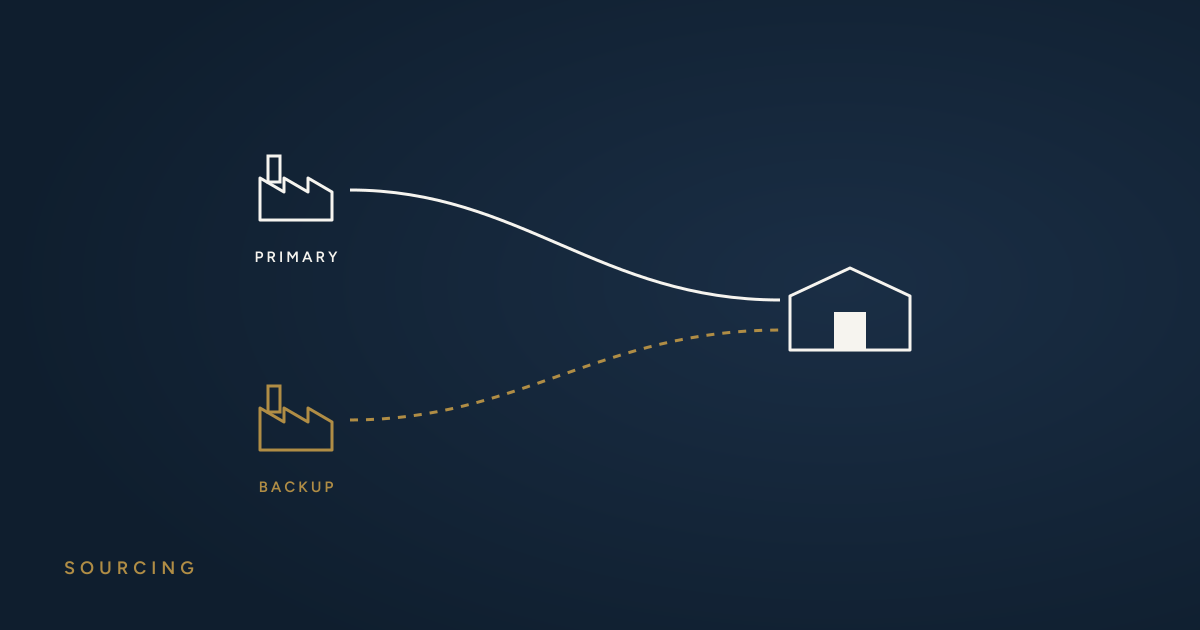
Most DTC brands find a supplier, place an order, and keep reordering until something goes wrong: a factory shuts, quality slips, a tariff lands or the supplier raises prices because they know you can't move. Strategic sourcing is deciding in advance what you'll do when that happens, and setting things up so it hurts less.
1. Segment your products and suppliers
Not every SKU deserves the same effort. A simple way to sort them uses two questions:
- How much does this item matter to revenue or margin?
- How hard would it be to source elsewhere?
That gives four groups, a version of the Kraljic matrix procurement teams use:
- Strategic (high impact, hard to replace): your hero products. These need the most attention, the closest supplier relationships and a backup plan.
- Bottleneck (low impact, hard to replace): small items with one capable supplier, like a custom component. Secure supply and hold buffer stock.
- Leverage (high impact, easy to replace): products many factories can make. Negotiate hard and compare regularly.
- Routine (low impact, easy to replace): packaging and accessories. Keep it simple and efficient.
2. Don't single-source your hero products
If one factory makes the products that drive most of your revenue, you have a single point of failure. Options, from lightest to heaviest:
- A qualified backup: a second supplier who has made approved samples and could take an order at short notice.
- Split volume: 70/30 or 80/20 between two suppliers, so the second stays warm and you always have a price comparison.
- Country diversification: a second source in a different country, to reduce exposure to tariffs, regional shutdowns and port disruption. Vietnam, India and Mexico are common alternatives to China, each with different strengths, costs and lead times.
Moving production takes longer than most brands expect. New tooling, samples, testing and first-run quality issues often take six months or more, so start before you need to.
3. Own what you can
- Tooling and moulds: agree in writing that you own them, and that they can be moved.
- Specifications: keep full product specs, materials lists and packaging specs yourself, not only in the supplier's files.
- Certifications and test reports: make sure they're in your name, or that you hold copies.
If the supplier holds all of these, switching is much harder, and they know it.
4. Control quality before it ships
Once goods are on a ship, fixing a quality problem gets expensive. Use third-party inspections before shipment, sampled against an agreed acceptance level (AQL). Agree in the purchase order what happens if a shipment fails: rework, replacement or a price reduction. Keep golden samples on both sides.
5. Keep a simple risk register
List your top risks, and for each one note how likely it is, how much it would hurt, and what you'll do about it. For most DTC brands, the list includes:
- Supplier failure or capacity loss
- Tariff or trade policy changes
- Freight disruption and rate spikes
- Quality failures
- Currency movements
- Peak-season capacity at the factory, forwarder or 3PL
Review it every quarter. It doesn't need to be complicated. It needs to exist.
6. Treat suppliers as partners
Share forecasts, pay on time, and visit when you can. Suppliers give their best capacity, prices and attention to the customers who are easiest and most reliable to work with. That goodwill is a form of risk management too.
Frequently asked questions
Should a small DTC brand dual-source?
For your top one or two SKUs, yes, once volume allows an order that meets both suppliers' minimums. For the long tail, a qualified backup supplier you have sampled from is usually enough.
Is nearshoring worth a higher unit price?
Often, for fast-moving SKUs. A shorter lead time cuts safety stock and order sizes, and you pay closer to when you sell. Run the numbers on total cost, not unit price.
How do I score supplier risk?
Rate each supplier on concentration (share of your revenue), financial stability, geography, lead time reliability and quality history. Anything that scores high on concentration and low on reliability needs a backup first.
Want this checked on your own numbers?
Start with a fixed-scope audit of your invoices, contracts and inventory data, or bring us in to fix a specific problem. Either way, the first call is free.
Book a call